Run to the Sun
How and why Japan became an attractive destination for the Chinese middle-class.
2026-03-01(Sun) 17:00 AST
First, a history
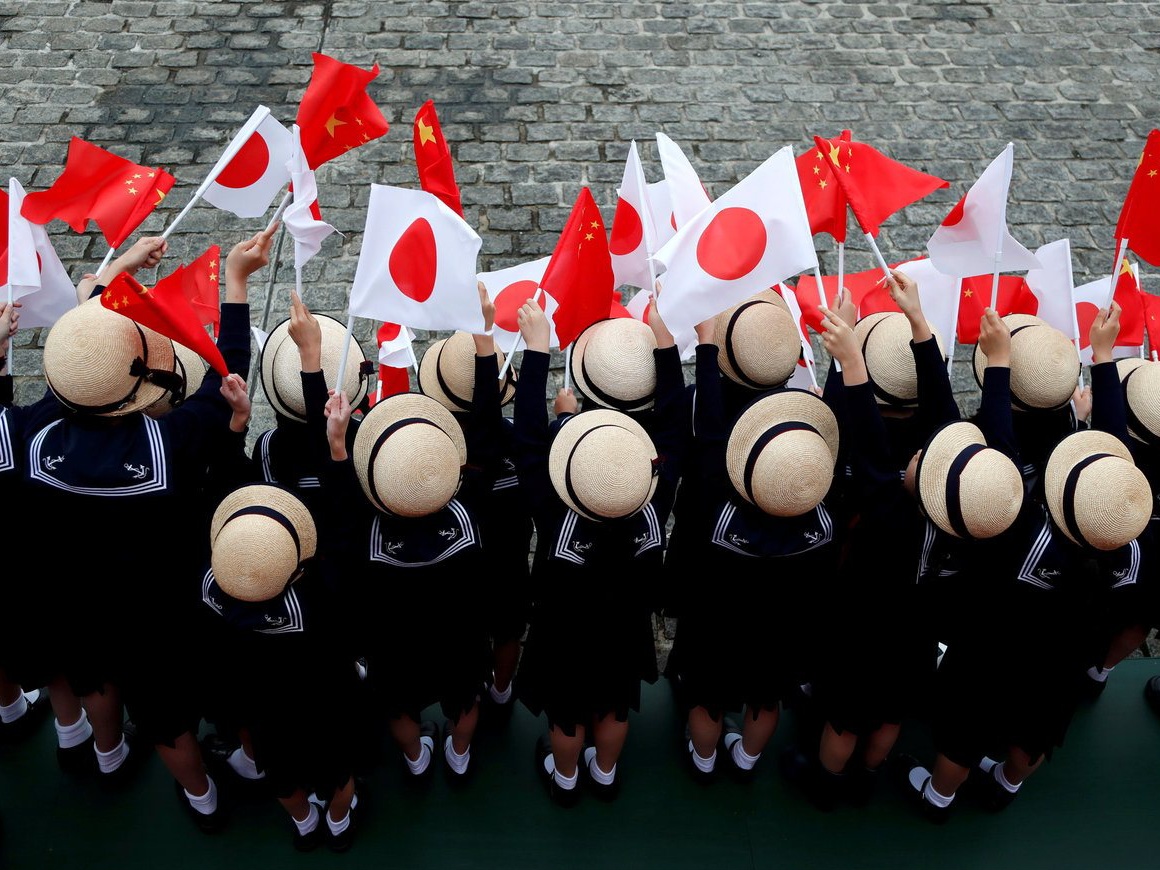
In Chinese, the character 润 means to moisten, or also to prosper. Its Mandarin pinyin romanisation is "run", which happens to also be an English word. This was too good a coincidence for Chinese internet users to pass up, and so 润 became slang for emigration; for getting out.
润学 (Runxue/Runology), the "Study of Run" or the study of getting out as it is also called, originated in 2018. But by 2022, the convergence of involutionary pressures, strict Zero-COVID policies particularly in Shanghai, and increased pessimism amongst Chinese people online, resulted in it becoming mainstream that year. Runology is an expressive form of Sinopessimism which has a bitter connotation and which sees the only hope for Chinese people to be the act of 润. A GitHub manifesto puts it religiously in a very literal sense; 润 is "the only true religion" of the Chinese people, a "physical salvation" from a real-world hell.
15 thousand high-net-worth Chinese individuals left the country in 2024 alone. Net emigration reached 310 thousand in 2022, the year of the Shanghai lockdown, and hasn't declined much since. Billions; maybe tens or hundreds of billions of yuan, flowed from China to the same few old countries. America, Canada, Australia, increasingly the United Kingdom and New Zealand. These countries have long been the preferred destinations of the middle-upper-class and upper-class Chinese migrant.
But you can now add Japan to that list. Japan's history with Chinese immigration is not new. China began overtaking South Korea as the biggest source of Japan's immigrants in the 2000s, and even before then, many Chinese lived integrated lives. But they were not the same people that run to Japan now. The first wave of Chinese immigration that ran from the 80s to the 2010s (with the most coming in the 2000s) consisted of relatively simple people, mostly students, labourers, and small business operators from Fujian and the three northeastern provinces. These people came because Japan was richer and because it had work. They didn't have many assets, lived in the cheaper parts of the country, and despite being supportive of the Communist Party, were also keen on assimilating; many of them learned Japanese.
The second wave, which began arriving in the 2010s and accelerated after 2022, are not like the first.
Runri
Wang Yi (王懿), better known as Akid, was a former Chinese journalist who worked for the now-banned outlet Elephant Magazine (大象公会); when the outlet shuttered in 2021, Akid went to Japan afterwards. She had been suffering from anorexia before, but it had gotten worse while she lived there. In August 2023, she died.
The nationalist parts of the Chinese internet made an exhibition out of her death, claiming that she deserved it and that this is what a life in Japan would actually be like for many Chinese migrants there. The sensationalisation of her death to such an extent would be shocking to anyone else, but completely normal on the Chinese internet, where toxicity runs freely on any and all sides involved.
Akid was not the usual 润日 (runri, "Run to Japan") migrant, but she helps explain one motive out of many for why one would move to Japan instead of stay or move elsewhere.
In contrast to the first wavers, the typical runri arrival is a professional from a Tier One Chinese city; Beijing, Shanghai, Shenzhen, Guangzhou. They are not learning Japanese, nor do they intend to. They have a seething hatred for the Communist Party and Xi Jinping specifically. They compare Japan with Canada and Australia, and they choose Japan because it is geographically and culturally close, affordable relative to other first-world options, and remarkably easy to enter. The business manager visa required a mere ¥5 million in registered capital at the time many runri moved. The highly skilled professional visa, which many runri acquire, can be processed in under a month and grants five years of residency. By contrast, similar programmes in Europe and Oceania have been tightening for years.
The vast majority of runri can be divided into three rough tiers. The first tier are the ultra wealthy; retired tech founders, real estate magnates, and so on. This includes people like Jack Ma who have been spotted living around Kyoto and Tokyo. The second tier are the upper-middle-class; former executives, accountants, entrepreneurs, people who can buy an apartment worth hundreds of millions of yen in Chiyoda or a house worth half a billion in Hiroo. The third tier are the "anxious" middle-class; young professionals, sometimes with their families, but otherwise usually DINK couples from the tech industry. They leave behind the tech life in China for a smaller apartment in Tokyo and attempt to restart their life.
The thing that binds these tiers of runri arrivals, and the ones that don't fit into these tiers neatly either, are a shared set of motivations, really anxieties: They are anxious their assets wouldn't be respected in China, anxious their children would suffer under an involutionary system that pressures students, anxious about their freedom, and anxious about their safety, in that general order. As I have said before in this piece, runri immigration accelerated significantly with the Shanghai lockdown in 2022. One couple who moved to Japan stated that they did so after five days of lockdown that year, where after they went out, they broke down and started crying over the smell of lamb skewers, overwhelming them.
Where do they move?
The first wavers moved into areas where the old, assimilated Chinese lived. Either that, or just in general moved into the cheaper areas of the country. The outer suburbs of Tokyo and Osaka, and the rural parts of Japan. Compare this to the runri who have resettled themselves, with striking specificity, into a handful of Tokyo neighbourhoods. Koto, Chuo, Minato, and Shinagawa are named as particular favourites. Tokyo's waterfront high-rises offer something that Chinese migrants from megacities find familiar: new construction, spacious common areas, panoramic views, proximity to commercial districts. And they are cheap, at least compared to Beijing. One runri arrival noted that a comparable apartment in Beijing would cost roughly 40% more per square metre than one in Toyosu. Speaking of Toyosu, a particular favourite complex for many runri is the Brands Tower Toyosu. This single apartment complex in this area of Tokyo is now stated to be around 15–20% Chinese, all of whom specifically recent, post-2022 runri arrivals.
Data follows these observations. Tokyo's central wards have seen disproportionate growth in their Chinese populations; between 2018 and 2023, while the overall Chinese population in Tokyo's 23 wards grew by about 15%, Bunkyo, Chuo, and Chiyoda all had growth rates above 50%. Old favourites of the first wavers, like Kawaguchi in Saitama, only grew by around 10–15%.
Now, many people talk about runri arrivals in Tokyo, and the money that follows with them, but many runri have also seen investment opportunities outside of the city. Jack Ma's private residence is in Kyoto. In Fukuoka, a Hong Kong diaspora community has established itself. In rural Hokkaido, especially in areas like Niseko, and various prefectures, Chinese developers are buying land and launching construction projects, sometimes described in Japanese media with the neologism 爆建て (bakudate, "explosive building"), a play on the already established 爆買い (bakugai, "explosive buying") that was coined to describe Chinese tourist shopping sprees.
The total number of Chinese residents in Japan, including those from the mainland, Hong Kong, Macau, and Taiwan, reached about 943,000 by mid 2024 and is projected to exceed one million by the end of 2026. Now, the runri proper as distinct from earlier waves of migration and from non-Mainland migration number perhaps 20% at most; but their economic weight is disproportionate to their numbers. Chinese nationals now account for over half of all business manager visa holders in Japan, and about two-thirds of highly skilled professional visa holders.
The effects on China and Japan
The runri phenomenon specifically, and Runology/Sinopessimism in general, is at its core, a form of dissatisfaction with the current state of China. China was never expected to grow as big as it did; even the most nationalist newspapers in 2000 predicted that China would be lucky to surpass Japan in GDP by 2050. They did so by 2010. The explosive growth that defined the 2000s gave way to more mellow growth by the 2010s and 2020s, and the problems of rapid development at all costs began to show their ugly faces right as growth also began to slow.
The current generation of China, a part of which participates in Runology and Sinopessimism, share similarities with their East Asian counterparts, the N-po generation in Korea and the Satori generation in Japan. The fact that all three countries have young people who have seemingly "given up" at differing stages of economic development shows that what China is experiencing is not necessarily new. But nevertheless it is important to show the effects of this generation, both the effects on China and on Japan.
For China, one very interesting thing to note is the hostility directed at those who engage in Runology, especially runri. Online hostility is by no means new on the Internet, but the sheer vitriol is hard to describe in words. Akid's death was celebrated, she was called a hanjian, and her death was called a rightful punishment for loving Japan. Before her death happened, nationalists watched her deteriorate and encouraged her eating disorders.
Fang Kecheng describes this as a form of "Internet Cultural Revolution", and while I disagree with the terminology, it does have a correct main point in that the mob, not the state, polices loyalty on the spheres of the Chinese internet. A lot of this is genuine patriotism and nationalism, and only a small amount of it is probably bots, unlike the perception in The West where anyone who supports China is seen as wumao. This hostility has a chilling effect. Many runri keep their move secret from friends and extended family; one man told his relatives he had been laid off and was going to Japan for work, unable to explain the real reasons to family members who held anti-Japanese views.
For Japan, it further polarises an already existing debate on immigration. Three percent of the population is foreign-born already. That number rises to ten percent of the population in their 20s. That number rises further to a third of the working-age population in Shinjuku.
The runri add a new element to the dynamic. Japan's history with immigration is not new; Japan's history with wealthy immigrants is. For many Japanese people, it will be the first time they will see another Asian who is richer than they are. They buy properties in cash, often through underground banking networks that circumvent China's $50,000 annual foreign exchange limit. They drive up housing prices in exactly the neighbourhoods where young Japanese families are trying to buy. They send their children to international schools and to elite Japanese cram schools; a "shadow SAPIX" network, where Chinese parents share prep materials and strategies through WeChat, exists.
This does a lot to the psychology of a nation that prides itself on being the most "mature" Asian economy. A huge majority of Japanese people hold negative views of China, and this colours perceptions of the newcomers. There is genuine friction between the runri and established first waver communities, too. Longer-term Chinese residents, who learned Japanese, integrated into local society over decades, and who are supportive of China but are otherwise apolitical, resent newcomers who arrive with more money, less interest in assimilation, and more interest in fighting Chinese political battles outside the country. One established resident, quoted in a Nippon piece, described the newcomers as "always pushing the Chinese way."
But the interest in fighting Chinese political battles outside the country has had a not-unwanted side effect. Since around 2022, a cluster of Chinese-language bookstores have opened in the city: 单向街 (Danxiang) in Ginza, 局外人書店 (Juwairen Bookstore) in Jimbocho, and the upcoming Tokyo branch of 飛地 (Tobichi) in Shinjuku. These bookstores function as retail spaces, but also as salons, hosting events with writers, journalists, filmmakers, and legal scholars who can no longer do their work as freely as they used to in mainland China or, increasingly, in Hong Kong.
This matters for Japan beyond the cultural interest. If Japan is going to accept large numbers of immigrants, as its demographic trajectory essentially requires, receiving educated, wealthy, liberal-minded migrants who already share a writing system and significant cultural (and literal) DNA is about as good as it gets. The question is whether Japan's political system and public sentiment will allow the country to take advantage of this. The country has never articulated a coherent vision for what kind of immigration it wants, and the arrival of the runri is forcing the question in ways that are proving uncomfortable.
What this means
The existence of the runri, in a way, should be flattering for Japan. In spite of being relentlessly critiqued, the country offers enough to rich Chinese immigrants of all people that they are moving there en masse. One anecdote is that many runri say that Japanese apples go bad quickly and naturally, unlike Chinese ones, supposedly sprayed with pesticides, a selling point on Japan being a more "normal" country for a group of people seeking normalcy. The runri arrivals are also a vote of confidence in the economic future of Japan. Almost all runri arrivals you will meet will be far more optimistic about the Japanese economy than any Japanese person.
For the runri themselves, many take "small but certain happiness"; a term many of you who read Haruki Murakami would be familiar with. A young Chinese couple, sitting in their Tokyo apartment watching the CCTV Spring Festival Gala that they turned off after five minutes because PLA soldiers were marching on stage, used it to describe what Japan gave them. Not luxury. Not even certainty about the future. Just the space to live without fear, the four anxieties I previously laid out soothed.
Akid shows that some people are willing to suffer for this. She was cremated in Hachioji. Her bones were purely white. She said that she ultimately felt happier in the 10 months of her poor life in Japan than at any previous point.
This article is a bit of an experiment. It is sort of like my previous two articles, but it is also partially a book review.
I used many sources, in Chinese, Japanese, and English, for this article, but my main source was the book Runri by Takehiro Masutomo. No English translation exists yet, and I don't want to make one because I don't want to play around with Japanese copyright law, but I seriously recommend you buy and read the book if you can understand either Japanese (the original language) or Chinese (a translation of the book exists); most anecdotes and data (and claims such as the anxiety hierarchy) were pulled from the book, and backed up by more data elsewhere.